Villas of Tuscany

Tuscan villas are classic architecture and immensely popular as vacation rentals in Tuscany. Villas to rent in Tuscany, vacation villa in Tuscany, Tuscan villa for your holiday in Tuscany, Tuscan villas accommodations in Tuscany

Vacation Villa in Tuscany, Rome and the Veneto :: 2008

Tuscan Villas Tuscan Villa Gardens Tuscan Villa Bibliography

Tuscan Villa Villas of Tuscany

La Petraia - a classic Renaissance Tuscan villa near Florence

Villas of Ancient Rome

The term "Tuscan villa" is sometimes applied rather indiscriminately to any largish house located in the region of Tuscany (or even in Florida), not rarely by the rental real estate industry. In fact, a villa was originally a Roman country house built for a member of the upper classes or imperial family. Pliny the Elder divided villas into two kinds, the villa urbana, which was a country seat that could easily be reached from Rome (or another city) for a night or two, and the villa rustica, the farm house estate, permanently occupied by the slaves and the factor who had general charge of the estate, centred on the villa itself which might be only seasonally occupied. There was a concentration of Imperial villas near the Bay of Naples, especially on Capri, at Monte Circeo on the coast and at Antium (Anzio). Wealthy Romans escaped the summer heat into the hills around Rome, especially near Frascati where Hadrian's Villa is located. Cicero is said to have possessed no fewer than seven villas, the oldest of which was near Arpinum. Pliny the Younger had three or four, of which the example near Laurentium is the best known from his descriptions.

Our knowledge of the form and organisation of Renaissance villa architecture depend upon literary descriptions provided by the authors of ancient Rome. In particular, Columella (4–70 A.D.) in De re rustica and Cato (234–149 B.C.) in De agricultura elaborate on the features of their villas in the Campagna, the low-lying area surrounding Rome. Commonly in ancient writings, the villa exerts restorative powers due its natural setting or otium, in contrast to the excesses of city life, or negotium. Horace (65–8 B.C.) extolled the simple virtues and pleasures of ancient villa life in his poetry.

Pliny the Younger (ca. 61–112), in his Letters (Epistle to Gallus 2.17; Epistle to Apollinaris 5.6), persuaded later patrons and architects of the beauty afforded by his Laurentine and Tuscan villas. His descriptions provided images of the general appearance of the villas and introduced the reader to the experience of intertwined interior and exterior architectural features. Pliny's retreats slipped into the landscape with terraced gardens and opened outward to natural surroundings through loggias, which replaced solid enclosing walls. The author retired to the gardens, or horti, to appreciate the abundance of flora and fauna. The cultural life of poetry, art and letters unfurled in a setting that was distinctly different from the urban experience of Rome. Relying on initial reconstructions by Vincenzo Scamozzi (1552–1616), later architects would turn to Pliny's descriptions to imagine the spaces and experience of the ancient villa.

Roman writers refer with satisfaction to the self-sufficiency of their villas, where they drank their own wine and pressed their own oil, not unlike the foreign inhabitants of Tuscany today. The villa thus holds a central place in the history of Western architecture. On the Italian peninsula in antiquity, and again during the Renaissance, the idea of a house built away from the city in a natural setting captured the imagination of wealthy patrons and architects. While the form of these structures changed over time and their location moved to suburban or even urban garden settings, the core design tenet remained an architectural expression of an idyllic setting for learned pursuits and spiritual withdrawal into a domestic retreat from city life.

Villa Felceto - holiday villa in Tuscany

Villa Felceto - holiday villa in Tuscany

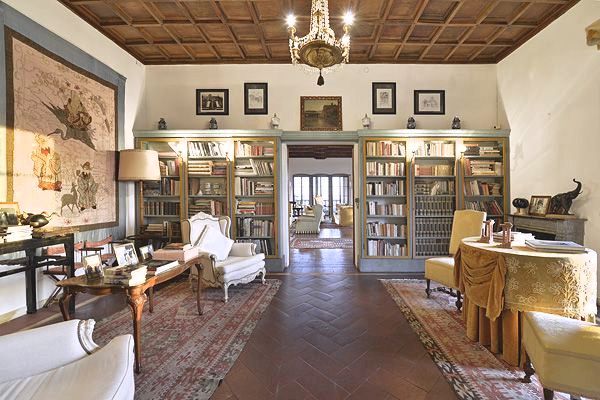
Podere Felceto is an organic olive oil farm with 57 acres of olives, vines and forest located in the centre of the Chianti Classico area of Tuscany, near Panzano in Chianti , halfway between Florence and Sienna. The farm buildings are grouped around a former monastery which has been converted into a large self-catering vacation villa. The villa provides accommodation for up to 13 persons on two floors. In addition to the large kitchen, an upstairs reading and television room, a billiards room, laundry room and other facilities, the villa has a spacious (44 sq m) dining and living room two storeys high.

Click here to learn more about the Villa Felceto holiday villa in Tuscany

Renaissance villas of Tuscany

Tuscan villa to rent

A Tuscan villa overlooking Florence

Tuscan vacation villas provide privacy and comfort for your vacation in Tuscany. Villa with pool to rent in Tuscany, Tuscan vacation villa for your holiday in Chianti, Tuscan villas accommodations in Chianti

In 14th and 15th century Italy, a 'villa' once more connoted a country house, sometimes the family seat of power like Villa Caprarola, but more often designed for seasonal pleasure, usually located within easy distance of a city. The first examples of Renaissance Tuscan villas date back to the period of Lorenzo de' Medici, and they include the Villa di Poggio a Caiano by Giuliano da Sangallo (begun in 1470) and the Villa Medici at Fiesole (1458–61), probably the first villa created under the instructions of Leon Battista Alberti, who theorised in his De re aedificatoria regarding the features of the new concept of "the villa". From that time onwards, the villa gardens were considered to form a seamless link between the residential building and the surrounding countryside.

In and around Florence during the 16 C, the
Medici family built a series of Tuscan villas integrated into a garden setting, such as the magnificently situated Villa Medici at Fiesole (1458–61) alluded to above, the inventive villa-park at Pratolino (now Villa Demidoff, 1569–81), and the delightful Villa La Petraia (1575–90), with its central belvedere overlooking the Arno River valley.

Villa Le Barone - an historical villa hotel in Tuscany

Historical Villa Hotel Tuscany

Villa Le Barone was initially a mediaeval tower built on the ruins of a Roman structure, probably also a military outpost. It came into the possession of the famous della Robbia family of Florentine ceramicists and artists who converted it into a villa and owned it for several hundred years. Just after World War I, the villa was restored by the Marchesa Maria Bianca Viviani della Robbia as a farm and not long afterwards was converted into a beautiful hotel. It is surrounded by italianate and modern gardens, and has a swimming pool and tennis court, and yet retains a great deal of the atmosphere of a private villa: an ideal base for visitors to Tuscany interested in staying in a Tuscan villa.

Click here to learn more about the Villa Le Barone Hotel


• Villa Medici at Fiesole
often considered to be largely the work of Michelozzo most likely owes its design to Leon Battista Alberti, and as such is the prototype of the Tuscan Renaissance villa. It enjoys a marvellous location in the cool hills of
Fiesole, overlooking Florence. More about Villa Medici at Fiesole.


Villa Medici at Fiesole


•
Villa Medicea di Cafaggiolo is a castellated Renaissance villa situated near Barberino di Mugello in the valley of the River Sieve (Val di Sieve), some 25 km north of Florence. It was one of the oldest and most favoured of the Medici family estates, having been in the possession of the family since the 14 C. The villa was reconstructed following designs of the famous Renaissance architect Michelozzo in 1452, becoming a meeting place for some of the greatest intellectuals of the Italian Renaissance. More about Villa Medicea di Cafaggiolo.


Villa Medicea di Cafaggiolo


• Villa Cetinale
is a 16 C Tuscan villa located near Sovicille south of Sienna. It was designed in the 1600s by Carlo Fontana, a pupil of Bernini, and built by Cardinal Flavio Chigi for his uncle Fabio Chigi, Pope Alexander VII. The gardens at Villa Cetinale are among the most beautiful in Italy. Cardinal Flavio Chigi left the Cetinale estate to his grandchildren, who retained the property for three centuries, until it was bought in 1977 by the English peer Lord Antony Lambton, who carried out careful, conservative restoration work that restored Villa Cetinale to its former glory. More about Villa Cetinale.


Villa Cetinale


• Villa Corsini a Mezzomonte
near Florence belonged to the Buondelmonti family in the 11 C. The building was initially a fortified farm. The current structure is in typical Renaissance style, a square with a central courtyard. The interior is famous for its magnificent frescoes representing scenes from "Orlando Furioso".
More about Villa Corsini a Mezzomonte.


• Villa Vignamaggio near Lamole and Greve in Chianti belonged to the Gherardini and later the Gherardi families and shows the influence of Brunelleschi in its fine facade. Its italianate garden was restored in the 20 C. More about Villa Vignamaggio.


• Villa Gamberaia
at Settignano near Florence. The designer of villa Gamberaia has not been identified, but building was begun in 1610 for Zanobi Lapi whose descendents laid out the gardens between 1624 and 1635. During the 18 C, the Capponi family embellished the grounds with statuary and fountains. Villa Gamberaia exemplifies Tuscan villas of the era in which a close association existed between the garden and its agricultural surroundings and which retained such conservative features as a limonaia, allιes, ilex groves, terracotta figures, sculptured hedges, and pebble mosaic walks.
More about Villa Gamberaia.


Villa Gamberaia


• Villa Demidoff at Pratolino. The Villa Medicea di Pratolino (Villa Demidoff di Pratolino) is a patrician villa located 12 km north of Florence. The original 16 C villa fell into decay and was demolished, and later the estate was bought by Prince Paolo Demidoff who, in 1872, had the pages' quarters turned into the existing villa. However, the park is magnificent and in it there are the remains of artificial caves and fountains. Of the original Renaissance property, what remains today is the colossal statue-fountain of the Apennine by Giambologna, together with the adjacent lake, the statue of the Mugnone and the hexagonal chapel designed by Buontalenti. More about Villa Demidoff.

Villa Demidoff at Pratolino

• Villa Celsa near Sovicille south of Sienna constructed as one of the Republic of Sienna's defence bastions and transformed into a villa in the 1500s by its owner, Mino Celsi. The villa retains its 16 C character despite numerous changes over the years. It has a splendid italianate garden laid out on one of its terraces, the elaborate layout and architectural additions creating an attractively striking effect. More about Villa Celsa.


Villa Celsa


• Villa medicea dell'Ambrogiana near Montelupo Fiorentino is a huge country villa used by the Medici as a hunting lodge. A contemporary picture by Giusto Utens shows spectacular italianate garden bounded by the Arno. It was used as a psychiatric prison for many years and is now restored and the park is open to the public. More about Villa dell'Ambrogiana.


Villa medicea dell'Ambrogiana


• Villa di Monaciano, in contrast to many other famous Tuscan villas, is not a renaissance structure but dates from the 18 C and reflects the stylistic renewal sweeping Florence at that time. It has a splendid English garden and an antique hothouse, still in use and evidence of the botanical interests of the founder of the villa, Alessandro Pucci Sansedoni, an 18 C Siennese nobleman living in Florence. More about Villa di Monaciano.


Villa di Monaciano


• Villas near Anghiari - the Upper Tiber Valley and the overlooking hills are the location of many ancient castles that have been turned into villas over the centuries. Among them are Castello Montauto, Castello dei Sorci, Castello Galbino and Villa La Barbolana. More about the Castles and Villas near Anghiari.

Castello di Galbino near Anghiari

• Villa Le Corti near San Casciano Val di Pesa is one of the finest Renaissance country villas in Tuscany. It has belonged to the Corsini family since 1427. In the early 17 C it was converted by the painter and architect Santi di Tito into an imposing rectangular edifice dominated by the twin towers still there today. The Villa ia surrounded by a splendid park. More about Villa Le Corti and the Corsini family.

Villa Le Corti

Renaissance villas near Rome

The architecture and landscape elements described by Pliny the Younger appear as part of the Roman tradition as embodied in the monumental Villa Adriana. Originally built by the Emperor Hadrian in the first century A.D (120s–130s), the villa extends across an area of more than 300 acres as a villa-estate combining the functions of imperial rule (negotium) and courtly leisure (otium). Having fallen into ruin, the vast archaeological site was recovered in the 15 C and many architects - including Francesco di Giorgio Martini (1439–1501/2), Andrea Palladio (1508–1580), and Pirro Ligorio (ca. 1510–1583) - excavated and recorded firsthand the details of Hadrian's design while consulting descriptive passages of the emperor's life at the villa from the Historia Augusta. Most notably, the architect-antiquarian Ligorio employed sculptural remains of the Villa Adriana in the Vatican gardens and as architectural spolia in his design of the nearby Villa d'Este (begun 1560). Ligorio's design for Cardinal Ippolito II d'Este (1509–1572) was one of the most splendid garden ensembles in Renaissance Italy and remains celebrated for its festive waterworks and terraced gardens. Like the descriptions of ancient villas consulted by Renaissance architects, the Villa d'Este commands spectacular vistas over the Roman campagna from its position high in the hills of Tivoli above the Villa Adriana.

The re-constructed grandeur of the ancient Roman villa-estate depended not only on written descriptions but also on the rediscovery of painted frescoes on the walls of antique ruins. Raphael (1483–1520) and his workshop reinterpreted the highly ornamental stucco details from their archaeological studies for the monumental
Villa Madama in Rome (begun 1517). The painted and sculpted relief grotesques portray narratives from ancient authors and follow antique examples from the Villa Adriana and the Domus Aurea. Similarly, for Pope Julius III del Monte, several architects - including Giacomo Barozzi da Vignola (1507–1573), Bartolomeo Ammanati (1511–1592), and Giorgio Vasari (1511–1574) - created ornate surfaces within the courtyard, loggia and grotto at the retreat in suburban Rome known as the Villa Giulia (1551–53).

Inspired by ancient precedent, Giacomo Barozzi da Vignola adapted an enormous pentagonal-shaped fortified structure into his design for the
Villa Farnese (begun 1556), which integrated the concepts of the Roman garden and villa within an invented form featuring a circular courtyard. In the late 16 C and early 17 C, as the Roman elite turned to building country retreats, other architects began to specialise in villa architecture with increasing latitude from historical precedent. Skillfully blending principles of classical form with the Baroque ideas of unity, grandeur and the spectacular, their designs unified the architecture of the surface, interior and landscape setting into a carefully arranged decorative whole.

Rome had more than its share of villas with easy reach of the small 16 C city: the progenitor, the first villa suburbana built since Antiquity, was the Belvedere or palazzetto, designed by Antonio Pollaiuolo and built on the slope above the Vatican Palace. The Villa Madama, the design of which, attributed to Raphael and carried out by Giulio Romano in 1520, was one of the most influential private houses ever built; elements derived from Villa Madama appeared in villas through the 19 C. Villa Albani was built near the Porta Salaria. Others are the Villa Borghese; the Villa Doria Pamphili (1650); the Villa Giulia of Pope Julius III (1550), designed by Vignola.

Beautiful ornamental facades, elaborate entrance gates and gardens, replete with fantastic water displays and antique statues, formed the stage for the grand theatrical entertainments of the day. Noteworthy examples include the immense villa gardens on the Pincio and Gianiculum hills associated with the powerful families of Rome such as the Villa Pincian (now Villa Borghese, 1612–13), the Villa Medici (1540/1574–77), and the Villa Doria Pamphilj (1644–52) on the Gianiculum. Equally vast estates were laid out in the Alban hills outside Rome at Frascati, including the Villa Aldobrandini (1598–1603) and the Villa Mondragone (1573–77).

Villa Matassi - Roman holiday villa

Roman vacation villa

Villa Matassi is a luxurious 18 C country house located 10 km from Tivoli and an hour from the nearest Rome metro station. Ciampino airport is 40 km away. The villa accommodates 8 persons and is situated in walled grounds decorated with Roman antiquities. There is a large swimming pool and the gardens are shaded by pines and cypresses. Catering is available and there is a full-time custodian. Ideal for a tranquil and stress-free vacation convenient for day visits to Rome and the sights of the Roman Campagna.

Click here to learn more about the Villa Matassi holiday villa in the Roman countryside

Villa "Gli Eucalipti" - vacation villa near Rome

Holiday villa near Rome

Villa "Gli Eucalipti" is located in the rolling countryside of the Parco di Veio archaeological park directly north of Rome. The villa itself accommodates 6 persons and there are additional rooms in the annexes. This has proven to be a wonderful location for wedding celebrations in addition to providing a fabulous vacation location within easy driving distance of central Rome and the Roman lake district.

Click here to learn more about the Villa "Gli Eucalipti" holiday villa near Rome

Palladio and the villas of the Veneto

A variation of the Roman villa ideal developed on the mainland of the Venetian republic in the 16 C and 17 C, partly driven by noble families improving their estates, The villa designs in the Veneto reflect Renaissance ideas promoted by humanist scholars and illustrated in the pages of architectural treatises printed in Venice by Italy's most prolific presses. The 1511 edition of Vitruvius' De architectura, prepared by the Franciscan friar and architect Giovanni Giocondo da Verona (ca. 1433–1515), added woodblock pictures of ancient buildings to illustrate the notoriously difficult first-century B.C. text. With nearly equal importance given to words and pictures, Sebastiano Serlio (1475–1554) amended ancient models with contemporary Roman examples in his books Regole generali di architettura (1537) and Il terzo libro de le Antiquita (1540), the first two published volumes of his multivolume treatise. Serlio described the fresco perspective views at the Villa Farnesina (1509–11) as the extension of the interior space into the landscape, and he highlighted the siting of the Villa Madama "amongst all the elements required for pleasure." Vincenzo Scamozzi's L'idea della architettura universale (1615) recorded the rebirth of the ancient Roman texts and the unity of geometry and proportion within architecture. The most prominent of the Venetian humanist-architects to claim the heritage of ancient Rome was Andrea Palladio (born Andrea di Pietro della Gondola), who promoted the antique tradition of his activity in I quattro libri dell'architettura (1570).

Palladio mastered a formula of the ideal villa as a type. In his design methodology, he united the humanist understanding of otium with a repeating set of architectural rules governed by his reinterpretation of principles of proportion from ancient Roman precedent. Palladio's villa designs are typically organised with symmetrical plans and incorporating the antique temple front as a portico. Notable examples include the
Villa Barbaro at Maser (1557–58) and the Villa Almerico-Capra - La Rotunda, near Vicenza (1566–69). These two buildings demonstrate Palladio's ability to design a versatile range of villa elements with extended rectangular shapes and square block forms. At the Villa Barbaro, the solid walls transform into a loggia, a painted representation drawing the natural surroundings into the central hall, or sala, with allegorical depictions of the seasons and scenes from contemporary villa life executed in 1561 by Paolo Veronese (1528–1588). In Palladio's design for the Villa Almerico-Capra, four identical porticos with temple-fronts and broad rising staircases are arrayed symmetrically on perpendicular axes about a circular sala at the centre of the building. The villa is advantageously placed on a hilltop and dominates the landscape when viewed across the fields. Palladio's invention parallels the unusual combination of forms at the Villa Adriana in Rome, as he crowns the building with a dome recalling the ancient Roman example of the Pantheon.

Villa Barbaro

Villa Barbaro at Maser
Villa La Rotunda

Villa Capra "La Rotonda" in Vicenza

Tuscan Villas Tuscan Villa Gardens Tuscan Villa Bibliography

Tuscan Villas to rent for vacations